
Upcomming Events
-
27Aashadha
-
28AashadhaPradosh Vrata tomorrow
-
29AashadhaBhanu Jayanti 2 days remaning
-
31AashadhaWorld Youth Skill Day 4 days remaning
-
1ShrawanSaune Shankranti/Luto Falne Din/Dakshinaayan Arambha 6 days remaning
-
5ShrawanSurya Pooja 10 days remaning
-
6ShrawanBudhastami Vrata/Gorakhkali Puja 11 days remaning
-
9ShrawanHarishayani Ekadashi Vrata/Chaturmaas Vrata Aarambha 14 days remaning
-
10ShrawanPradosh Vrata 15 days remaning
-
12ShrawanWorld Hepatitis Day 17 days remaning
-
13ShrawanGuru Purnima Vrata/Vyas Jayanti/World Tiger Day 18 days remaning
-
14Shrawan
-
15ShrawanKhir Khane Din 20 days remaning
-
16ShrawanWorld BreastFeeding Week 21 days remaning
-
18ShrawanVitak Katha Prarambha 23 days remaning
-
21ShrawanGorakhkali Puja 26 days remaning
-
23ShrawanNational Soil Conservation Day 28 days remaning
-
24Shrawan
-
25ShrawanSom Pradosh Vrata 30 days remaning
-
26ShrawanGathāṃmugaḥ Caḥhre 31 days remaning
-
27ShrawanInternational Youth Day 32 days remaning
-
28ShrawanGunla Parwa Arambha/World Calligraphy Day 33 days remaning
-
30ShrawanVaraha Jayanti 35 days remaning
-
1BhadraNag Panchami Barta/Tharu Guriya Parwa/Singh Sankranti 37 days remaning
-
2BhadraKalki Jayanti 38 days remaning
-
3BhadraTulasidas Jayanti/National Information Day/World Photography Day 39 days remaning
-
4BhadraGorakhkali Puja 40 days remaning
-
7BhadraPutrada Ekadashi Vrata 43 days remaning
-
9BhadraPradosh Vrata 45 days remaning
-
12Bhadra
-
13BhadraGaijatra/International Day Against Nuclear Tests 49 days remaning
-
14Bhadra
-
15BhadraNational Library Day 51 days remaning
-
16BhadraMangal Chauthi Vrata 52 days remaning
-
18BhadraGaura Saptami 54 days remaning
-
19BhadraShree Krishna Janmashtami/Gaura Parva/Gorakhkali Puja/Durwashtami 55 days remaning
-
20Bhadra
-
22BhadraAja Ekadashi Vrata/Nijamati Sewa Diwas 58 days remaning
-
23Bhadra
-
25BhadraWorld Suicide Prevention Day 61 days remaning
Jyotish
-
 Jyotish Damodar Poudelनेपाल संस्कृत विश्व बिद्यालय�...
-
Jyotish Pandit Mukunda Nepalज्योतिष पण्डित मुकुन्द नेपाल�...
-
Jyotish Smarika Acharyaबाल्मीकि बिद्यापिठ बाट ज्योत�...
-
Jyotish Vaman Sapkotaशिक्षा - व्याकरणाचार्य, पौरोही...
-
Jyotish Narayan Prasad Bhandariज्योतिषका उप-प्राध्यापक (lecturer of A...
-
 Jyotish Mukunda Sharmaस्वाध्याय, सत्सङ्ग र सदाचारजस�...
-
Jyotish Purushottam Ghimireनेपाल संस्कृत विश्वविद्यालय, �...
-
Jyotish Khageshwor Subediगुरुकुल पद्दति बाट ज्योतिषीय �...
-
 Jyotish Dharmendra Krishna Paudelशास्त्री धर्मेन्द्र कृष्ण पौ�...
-
Jyotish Mohan Ghimireसम्पुर्णानन्द संस्कृत विश्वव...
-
Jyotish Narayan Prasad Gautamगुरुकुल शिक्षा प्रणालीबाट ज्�...
-
Jyotish Krishna Prasad Bhandariउपप्राध्यापक (Asst. professor of Sanskrit) नेपा�...
-
Jyotish Hamro patroनेपाल संस्कृत विश्वविद्यालय �...
-
Jyotish Damodar Kaushikज्योतिष र व्याकरण विषयमा आचार�...
-
Jyotish Amrit Paudelवाराणसीकै सम्पूर्णानन्द संस्...
-
Jyotish Dipendra Khatiwadaसम्पुर्णानन्द संस्कृत बिश्वब...
-
Jyotish Deepak Prasad Kafleसम्पूर्णानन्द संस्कृत विश्वव...
-
 Jyotish Kuresh Pandey११ वर्षको अनुभवसहित विभिन्न ध�...
-
Jyotish Ghanashyam Pokharelनेपाल संस्कृत विश्वविद्यालयब...


call
Hororscope
 Mesh
Mesh Brish
Brish Mithun
 Karkat
  Singha
  Kanya
Kanya Tula
Tula Brischik
 Dhanu
Dhanu  Makar
Makar  Kumbha
 Meen
Meen
मेष (चु, चे, चो, ला, लि, लु, ले, लो, अ) नोकरी वा पेशामा तर्कशक्तिले अरुलाई प्रभावित पार्न सक्नुहुनेछ। महत्वकांक्षी योजना पूरा गर्नको लागि संघर्ष गर्नुपर्ला। स्वास्थ्यमा चिसोबाट जोगिनुहोस्। आजको शुभ रंग हरियो हो भने शुभ अंक ६ रहेको छ।



2082 Shrawan
7
Wednesday
Jul 23, 2025
साउन कृष्ण चतुर्दशी
Gathāṃmugaḥ Caḥhre
साउन कृष्ण चतुर्दशी

MY NOTE


गथांमुगः चःह्रे
Exclusive audio
Shrawan Krsihna Chaturdashi
This Chaturdashi is also considered a metal day. The significance of this Chartudashi is very different and practical among the Chartudashis of the year. It is believed that the procession started in the valley from this day.
The Existence of Ghosts and Gathāṃmugaḥ Caḥhre
All societies around the world have accepted the existence of ghosts in their own ways. Ghosts are given in the form of negative energy and the message that such negative energies can be used for the benefit of the society through Tantra Sadhana has been giving for centuries.
There are many stories in Kathmandu Valley, among which many stories are related to ghost stories. From the use of ghosts in the fields during planting to the horror stories of Khayaks are still heard in the streets of Kathmandu. There is a legend that ghosts used to be active throughout the sowing period since ghosts would be officially released on Akshaya Tritiya. In this way, instead of directly manifesting the ghosts themselves, they used to enter the ghosts in people and produce extraordinary working abilities. And since Ropai is not right to keep such ghosts in the society, there is a tradition of saying goodbye by making Gathāṃmugaḥ Caḥhre as a replica of the ghost on Shravan Krishna Chaturdashi.
What happens today?
I must elaborate on an ancient practice that happens only in Nepal, it's about assembling plates and bowls from the big leaves of specific plants. These bowls and plates made by leaves are called Duna, Bota, and Taparis and it's customary to use these pure plates and bowls in every Nepali traditional rituals. Gathāṃmugaḥ Caḥhre is the day when foods and offerings are kept in such paper bowls and plates and kept on crossroads, it is said that this day people offer such foods for ghosts and demons.
It is believed that by keeping such food and worshiping it, one can avoid the tantric intervention and effects caused by wind, fire, and various mantras including ghosts and vampires. Legend proves that even in Kathmandu, there have been monks and seekers skilled in Tantra Mantra since ancient times.
An escape from sorcery and evil movements.
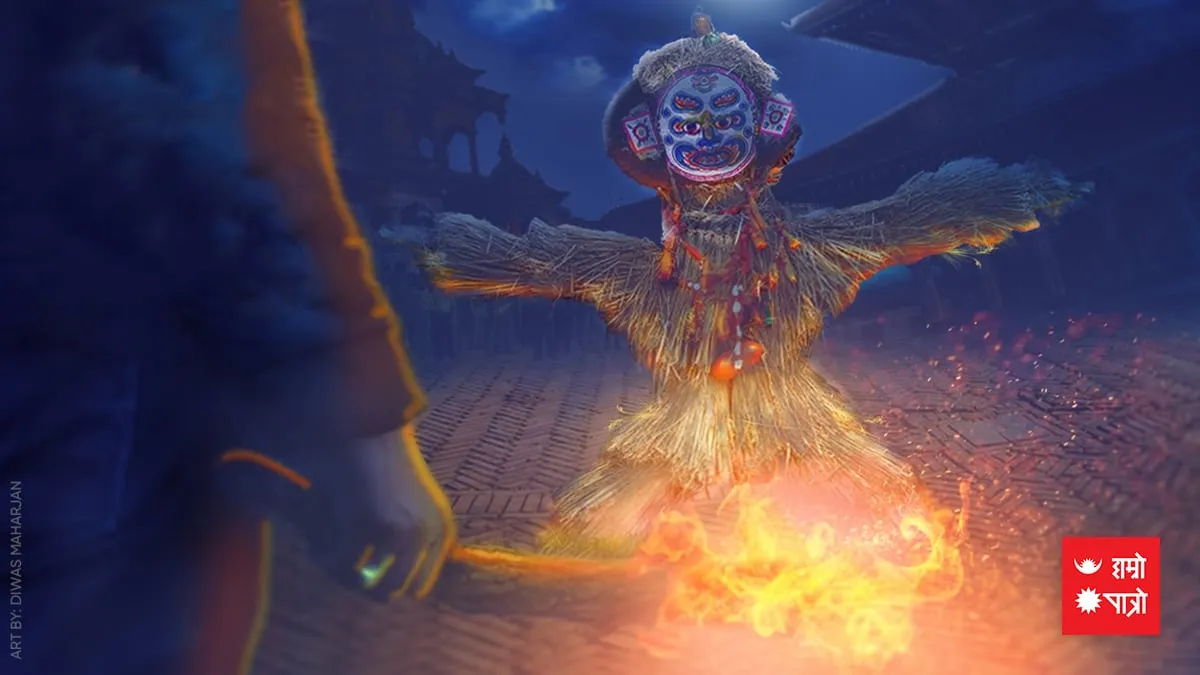
Gathāṃmugaḥ Caḥhre is considered a special day to escape from sorcery and evil movements. The death of a gigantic monster called Ghantakarna is also commemorated in Gathāṃmugaḥ Caḥhre. Ghantakarna is considered as a devout devotee of Lord Shiva in Sanatan Dharma and also as an envoy of Bhairav in Buddhism. Ghantakarna means scary with big ears. It is customary to turn the statues of many other demons and ghosts upside down for hours, and in doing so, it is customary for a man in a full blue robe to beg for alms from house to house.
In the end, such statues are carried to the river or burned. It is customary for the blue probe-wearing man to sit on top of the devil statues. In this sense, Gathāṃmugaḥ Caḥhre can be taken as a victory of humanity over evil forces.On this day, it is customary for people to wear a metal ring in the form of a Gathāṃmugaḥ Caḥhre ring. Gathāṃmugaḥ ring is believed to protect evil forces and even misfortunes.
The custom of pinning three nails on the main gate to ward off ghosts is another memorable custom of Gathāṃmugaḥ , old wooden doors have hundreds of nail pinned marks that showcase their existence and history.
Children make Gathāṃmugaḥ idols with bamboo and leaves and ask for voluntary donations from pedestrians. If someone refuses to donate in this way, the custom of shouting as the grandson of a demon is also amazing and fun. Gathāṃmugaḥ Caḥhre makes me believe that god and demons both have similar attractions in eastern and Sanatan philosophy. Lakhe dance also starts from Gathāṃmugaḥ , Lakhe dance lasts for a month. Gathāṃmugaḥ, which is a comparison between positive and negative forces and worships positive forces. Gathāṃmugaḥ Caḥhre is a day of excitement, enthusiasm, inspiration, and a smile.
Welcome to this historic gathāṃmugaḥ , which carries history from the Gopal Dynasty and the Lichhavi Dynasty. Gathāṃmugaḥ Caḥhre has celebrated all over Nepal indifferent ways. There is also a belief that if donations are made on this day in the temples, misfortunes can be avoided.
Upcomming Events
-
27Aashadha
-
28AashadhaPradosh Vrata tomorrow
-
29AashadhaBhanu Jayanti 2 days remaning
-
31AashadhaWorld Youth Skill Day 4 days remaning
-
1ShrawanSaune Shankranti/Luto Falne Din/Dakshinaayan Arambha 6 days remaning
-
5ShrawanSurya Pooja 10 days remaning
-
6ShrawanBudhastami Vrata/Gorakhkali Puja 11 days remaning
-
9ShrawanHarishayani Ekadashi Vrata/Chaturmaas Vrata Aarambha 14 days remaning
-
10ShrawanPradosh Vrata 15 days remaning
-
12ShrawanWorld Hepatitis Day 17 days remaning
-
13ShrawanGuru Purnima Vrata/Vyas Jayanti/World Tiger Day 18 days remaning
-
14Shrawan
-
15ShrawanKhir Khane Din 20 days remaning
-
16ShrawanWorld BreastFeeding Week 21 days remaning
-
18ShrawanVitak Katha Prarambha 23 days remaning
-
21ShrawanGorakhkali Puja 26 days remaning
-
23ShrawanNational Soil Conservation Day 28 days remaning
-
24Shrawan
-
25ShrawanSom Pradosh Vrata 30 days remaning
-
26ShrawanGathāṃmugaḥ Caḥhre 31 days remaning
-
27ShrawanInternational Youth Day 32 days remaning
-
28ShrawanGunla Parwa Arambha/World Calligraphy Day 33 days remaning
-
30ShrawanVaraha Jayanti 35 days remaning
-
1BhadraNag Panchami Barta/Tharu Guriya Parwa/Singh Sankranti 37 days remaning
-
2BhadraKalki Jayanti 38 days remaning
-
3BhadraTulasidas Jayanti/National Information Day/World Photography Day 39 days remaning
-
4BhadraGorakhkali Puja 40 days remaning
-
7BhadraPutrada Ekadashi Vrata 43 days remaning
-
9BhadraPradosh Vrata 45 days remaning
-
12Bhadra
-
13BhadraGaijatra/International Day Against Nuclear Tests 49 days remaning
-
14Bhadra
-
15BhadraNational Library Day 51 days remaning
-
16BhadraMangal Chauthi Vrata 52 days remaning
-
18BhadraGaura Saptami 54 days remaning
-
19BhadraShree Krishna Janmashtami/Gaura Parva/Gorakhkali Puja/Durwashtami 55 days remaning
-
20Bhadra
-
22BhadraAja Ekadashi Vrata/Nijamati Sewa Diwas 58 days remaning
-
23Bhadra
-
25BhadraWorld Suicide Prevention Day 61 days remaning
Jyotish
-
Jyotish Damodar Poudelनेपाल संस्कृत विश्व बिद्यालय�...
-
Jyotish Pandit Mukunda Nepalज्योतिष पण्डित मुकुन्द नेपाल�...
-
Jyotish Smarika Acharyaबाल्मीकि बिद्यापिठ बाट ज्योत�...
-
Jyotish Vaman Sapkotaशिक्षा - व्याकरणाचार्य, पौरोही...
-
Jyotish Narayan Prasad Bhandariज्योतिषका उप-प्राध्यापक (lecturer of A...
-
Jyotish Mukunda Sharmaस्वाध्याय, सत्सङ्ग र सदाचारजस�...
-
Jyotish Purushottam Ghimireनेपाल संस्कृत विश्वविद्यालय, �...
-
Jyotish Khageshwor Subediगुरुकुल पद्दति बाट ज्योतिषीय �...
-
Jyotish Dharmendra Krishna Paudelशास्त्री धर्मेन्द्र कृष्ण पौ�...
-
Jyotish Mohan Ghimireसम्पुर्णानन्द संस्कृत विश्वव...
-
Jyotish Narayan Prasad Gautamगुरुकुल शिक्षा प्रणालीबाट ज्�...
-
Jyotish Krishna Prasad Bhandariउपप्राध्यापक (Asst. professor of Sanskrit) नेपा�...
-
Jyotish Hamro patroनेपाल संस्कृत विश्वविद्यालय �...
-
Jyotish Damodar Kaushikज्योतिष र व्याकरण विषयमा आचार�...
-
Jyotish Amrit Paudelवाराणसीकै सम्पूर्णानन्द संस्...
-
Jyotish Dipendra Khatiwadaसम्पुर्णानन्द संस्कृत बिश्वब...
-
Jyotish Deepak Prasad Kafleसम्पूर्णानन्द संस्कृत विश्वव...
-
Jyotish Kuresh Pandey११ वर्षको अनुभवसहित विभिन्न ध�...
-
Jyotish Ghanashyam Pokharelनेपाल संस्कृत विश्वविद्यालयब...
call
Hororscope
मेष (चु, चे, चो, ला, लि, लु, ले, लो, अ) नोकरी वा पेशामा तर्कशक्तिले अरुलाई प्रभावित पार्न सक्नुहुनेछ। महत्वकांक्षी योजना पूरा गर्नको लागि संघर्ष गर्नुपर्ला। स्वास्थ्यमा चिसोबाट जोगिनुहोस्। आजको शुभ रंग हरियो हो भने शुभ अंक ६ रहेको छ।




Liked by: