
Upcomming Events
-
1Shrawan
-
5ShrawanSurya Pooja 4 days remaning
-
6ShrawanBudhastami Vrata/Gorakhkali Puja 5 days remaning
-
9ShrawanHarishayani Ekadashi Vrata/Chaturmaas Vrata Aarambha 8 days remaning
-
10ShrawanPradosh Vrata 9 days remaning
-
12ShrawanWorld Hepatitis Day 11 days remaning
-
13ShrawanGuru Purnima Vrata/Vyas Jayanti/World Tiger Day 12 days remaning
-
14Shrawan
-
15ShrawanKhir Khane Din 14 days remaning
-
16ShrawanWorld BreastFeeding Week 15 days remaning
-
18ShrawanVitak Katha Prarambha 17 days remaning
-
21ShrawanGorakhkali Puja 20 days remaning
-
23ShrawanNational Soil Conservation Day 22 days remaning
-
24Shrawan
-
25ShrawanSom Pradosh Vrata 24 days remaning
-
26ShrawanGathāṃmugaḥ Caḥhre 25 days remaning
-
27ShrawanInternational Youth Day 26 days remaning
-
28ShrawanGunla Parwa Arambha/World Calligraphy Day 27 days remaning
-
30ShrawanVaraha Jayanti 29 days remaning
-
1BhadraNag Panchami Barta/Tharu Guriya Parwa/Singh Sankranti 31 days remaning
-
2BhadraKalki Jayanti 32 days remaning
-
3BhadraTulasidas Jayanti/National Information Day/World Photography Day 33 days remaning
-
4BhadraGorakhkali Puja 34 days remaning
-
7BhadraPutrada Ekadashi Vrata 37 days remaning
-
9BhadraPradosh Vrata 39 days remaning
-
12Bhadra
-
13BhadraGaijatra/International Day Against Nuclear Tests 43 days remaning
-
14Bhadra
-
15BhadraNational Library Day 45 days remaning
-
16BhadraMangal Chauthi Vrata 46 days remaning
-
18BhadraGaura Saptami 48 days remaning
-
19BhadraShree Krishna Janmashtami/Gaura Parva/Gorakhkali Puja/Durwashtami 49 days remaning
-
20Bhadra
-
22BhadraAja Ekadashi Vrata/Nijamati Sewa Diwas 52 days remaning
-
23Bhadra
-
25BhadraWorld Suicide Prevention Day 55 days remaning
-
26BhadraKunse Aunshi/Father's Day/Motiram Bhatta Janma Jayanti 56 days remaning
-
27BhadraWorld First Aid Day/Gunla Parwa Samapti 57 days remaning
-
28BhadraDar Khane Din 58 days remaning
-
29Bhadra
Jyotish
-
Jyotish Pandit Mukunda Nepalज्योतिष पण्डित मुकुन्द नेपाल�...
-
Jyotish Mohan Ghimireसम्पुर्णानन्द संस्कृत विश्वव...
-
 Jyotish Dharmendra Krishna Paudelशास्त्री धर्मेन्द्र कृष्ण पौ�...
-
 Jyotish Mukunda Sharmaस्वाध्याय, सत्सङ्ग र सदाचारजस�...
-
Jyotish Smarika Acharyaबाल्मीकि बिद्यापिठ बाट ज्योत�...
-
Jyotish Vaman Sapkotaशिक्षा - व्याकरणाचार्य, पौरोही...
-
Jyotish Purushottam Ghimireनेपाल संस्कृत विश्वविद्यालय, �...
-
Jyotish Hamro patroनेपाल संस्कृत विश्वविद्यालय �...
-
Jyotish Amrit Paudelवाराणसीकै सम्पूर्णानन्द संस्...
-
Jyotish Krishna Prasad Bhandariउपप्राध्यापक (Asst. professor of Sanskrit) नेपा�...
-
Jyotish Narayan Prasad Gautamगुरुकुल शिक्षा प्रणालीबाट ज्�...
-
 Jyotish Damodar Poudelनेपाल संस्कृत विश्व बिद्यालय�...
-
Jyotish Damodar Kaushikज्योतिष र व्याकरण विषयमा आचार�...
-
Jyotish Khageshwor Subediगुरुकुल पद्दति बाट ज्योतिषीय �...
-
 Jyotish Kuresh Pandey११ वर्षको अनुभवसहित विभिन्न ध�...
-
Jyotish Narayan Prasad Bhandariज्योतिषका उप-प्राध्यापक (lecturer of A...
-
Jyotish Deepak Prasad Kafleसम्पूर्णानन्द संस्कृत विश्वव...
-
Jyotish Dipendra Khatiwadaसम्पुर्णानन्द संस्कृत बिश्वब...
-
Jyotish Ghanashyam Pokharelनेपाल संस्कृत विश्वविद्यालयब...


call
Hororscope
 Mesh
Mesh Brish
Brish Mithun
 Karkat
  Singha
  Kanya
Kanya Tula
Tula Brischik
 Dhanu
Dhanu  Makar
Makar  Kumbha
 Meen
Meen
मेष (चु, चे, चो, ला, लि, लु, ले, लो, अ) महत्त्वपूर्ण निर्णयमा सफलता मिल्नेछ। जिम्मेवारी कुशलतापूर्वक पूरा गर्नुहुनेछ। परिवारसँग भएको सानो छलफलले राम्रो निष्कर्ष निकाल्नेछ। अरूको कुरा सुन्नुहोस्, तर निर्णय आफ्नै विचारले गर्नुहोस्। आजको शुभ रंग पहेलो हो भने शुभ अंक ३ रहेको छ।



2083 Shrawan
24
Sunday
Aug 09, 2026
साउन कृष्ण एकादशी
Kamika Ekadashi Vrata/International Day of the World's Indigenous Peoples
साउन कृष्ण एकादशी

MY NOTE


Kamika Ekadashi Vrata
कामिका एकादशी व्रत
Exclusive audio
Krishna Paksha of Shrawan
Welcome to the Ekadashi which falls on the Krishna Paksha of Shrawan, this holy Ekadashi is divinely named Kamika Ekadashi. One who fasts this day and honors Lord Vishnu gets rid of sins and attains lord Vishnu after death. Salvation is the eventual pursuit of Sanatana philosophy, the attaintment of Lord Hari or Vishnu is salvation and every Ekadashis are the divine doors to do so.
Relevance of Kamika Ekadashi from Bivarta Purana
Today I would like to turn the pages of Brahma Bivarta Purana on the auspicious occasion of this year's Shravan Krishna Ekadashi i.e. Kamika Ekadashi. It is written in the Ekadashi Mahapurana that one who listens to this Ekadashi Vrata Katha with devotion attains Baikuntha.
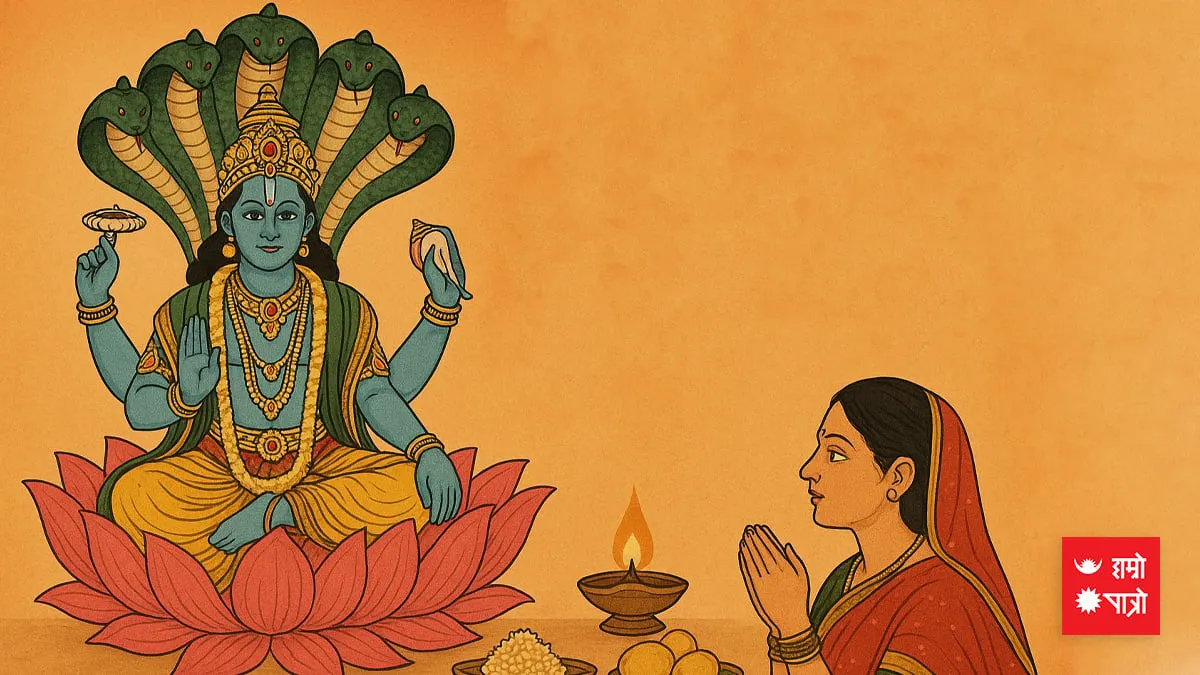
Here is the context in which Yudhisthira himself asks
Krishna. O Gobind Dev, please tell me the story of Kamika Ekadashi.
Krishna answers,
O King Yudhisthira, the truth-teller, and the great sage, of course, I will tell you in detail about this Ekadashi, about its vows which also bring about the remission of all sins.I would like to add another context, where Narad Muni once asked the creator Brahma about this Ekadashi. Although each Ekadashi has its own significance, the significance of this Ekadashi Kamika in the dedication of agriculture and rain of Shravan month is vividly different.
The result obtained after fasting this Ekadashi is as equivalent as performing Ashwomegha Yagya, the ultimate and herculean Yagya which takes a huge effort and sacrifice to get accomplished.
The fruit of this Ekadashi fast is more than taking a morning dip in the Ganges of Kashi or doing penance in the forest of Naimishrayan or Puskar. The importance of this Ekadashi for human welfare and salvation is actually described in several scriptures.
In Krishna's words "
It is said that fasting on Ekadashi is more fruitful than bathing in Kurukshetra on the day of the solar eclipse, more than bathing in Gandaki river where Shaligram resides, more than bathing in Godavari, donating cows and calves".
The spiritual relevance
The biggest disease and contagion in life is when we don't admit the mistake we have made, we fight with ourselves and laugh at our self-esteem. This Ekadashi has appealed to the devotees to come to the path of devotion by confessing their sins or mistakes and fast with devotion and dedication.
Even more than the study of the entire Vedas, Gita, and Puranas, the one who admits his mistake and fasts on this Ekadashi gets more salvation integrals. It is said that devotion to Lord Vishnu, the Lord of the Universe, and Hari, by offering basil leaves in devotion to this God, is associated with virtue on this Ekadashi. While worshiping Lord Hari, the leaves and buds of Tulsi are given the same status as gold, silver, or diamonds and the leaves and buds of Tulsi are equally important in this Ekadashi.
Even Yamaraj (God of the death) could not reckon the death of a devotee who offered water to Tulsi with devotion, such people have a higher spiritual consciousness. There is not much motivation to go to rivers or lakes in this Ekadashi, perhaps due to the increased and water level and dangers associated with it.
The use of grains and salt is forbidden in this Ekadashi. Although the importance of Ekadashi is so great, this Ekadashi Vrata Katha is not as special as other Ekadashis. However, let me write a summary of Vrakakatha, a rich man from a certain village accidentally kills a Brahmin by mistake.
He is liberated by fasting on Kamika Ekadashi, as the sages say, in order to atone for sins and atonement, even for murder. This Ekadashi is a wonderful Ekadashi, wishing a clean mind, a healthy body, and a peaceful earth. May this Ekadashi neutralize all unwanted harmful microorganisms and reestablish the devotion.
International Day of the World's Indigenous Peoples

अन्तर्राष्ट्रिय आदिवासी दिवस
Exclusive audio
Indigenous peoples across the globe
Over 476 million indigenous peoples are living in 90 countries across the world, accounting for 6.2 percent of the global population. Indigenous peoples are the holders of a vast diversity of unique cultures, traditions, languages, and knowledge systems. They have a special relationship with their lands and hold diverse concepts of development based on their worldviews and priorities.
Meaning of "Adi"
Indigenous people are called Adivasi in the Nepali language. 'Adi' refers to an ancient historical time, hence the people who have been living in a place for a very long time and have been cultivating the soil of that land for generations and have many original identities including arts and crafts are called AdiVasi.
Safeguarding indigenous people and their knowledge is the major issue today, their territories are home to 80% of the world's biodiversity and they teach us the balance of life and nature like no one else. The United Nations General Assembly on December 23, 1994, introduced the concept of celebrating August 9 as the International Day of Indigenous Peoples. The United Nations had earlier called for a decade from 1994 to 2004, including the Indigenous Decade for Action and Dignity.
The UN logo for the International Day of the World's Indigenous Peoples day was designed by Bangladeshi artist Reban Dewan. The logo features two green-eared ears that surround the earth. With the development of human civilization and the beginning of the migration, the density of immigrants has gradually increased and their identity, existence, different qualities, and customs have started to decrease.
Indigenous peoples, who make up 5 percent of the world's population, make up 15 percent of the worlds poor. The identity and presence of indigenous peoples from the polar regions of the earth to the South Pacific coast are declining as the later immigrant communities have been dominated by various sectors including occupation, identity, and settlement.
United Nations Declaration on the Rights of Indigenous People
Article 14 of the United Nations Declaration on the Rights of Indigenous Peoples states that indigenous peoples have the right to establish and control educational systems and institutions appropriate to their culture, language, customs, and traditions. Various studies have clearly shown the huge disparity between indigenous and non-indigenous communities in terms of educational opportunities, development, and overall human rights facilities.
Indigenous communities, who have been munching on nature for generations, are an ancient asset to the world, and maintaining their identity in the mainstream of development has been a major challenge for the world community. There are indigenous communities in most parts of Nepal, a multi-ethnic, multi-religious, and multicultural country, and they are rapidly trying to keep their identity, customs, and originality alive. Shockingly, things have not been able to continue and even their identity has been lost by changing their original surname.
The bitter truth is that their presence in their place will be more beneficial to the world and the community than to the cities, settlements, and connected factories built by displacing and dislocating the indigenous peoples.
A comfortable, simple, and developed society is the responsibility of all of us for the Adivasi community. Whether we are a non-Adivasi or Adivasi community, it is important to show the next generation a realistic picture of society and a reflection of the origin of development. Happy Adivasi Day to all!
Upcomming Events
-
1Shrawan
-
5ShrawanSurya Pooja 4 days remaning
-
6ShrawanBudhastami Vrata/Gorakhkali Puja 5 days remaning
-
9ShrawanHarishayani Ekadashi Vrata/Chaturmaas Vrata Aarambha 8 days remaning
-
10ShrawanPradosh Vrata 9 days remaning
-
12ShrawanWorld Hepatitis Day 11 days remaning
-
13ShrawanGuru Purnima Vrata/Vyas Jayanti/World Tiger Day 12 days remaning
-
14Shrawan
-
15ShrawanKhir Khane Din 14 days remaning
-
16ShrawanWorld BreastFeeding Week 15 days remaning
-
18ShrawanVitak Katha Prarambha 17 days remaning
-
21ShrawanGorakhkali Puja 20 days remaning
-
23ShrawanNational Soil Conservation Day 22 days remaning
-
24Shrawan
-
25ShrawanSom Pradosh Vrata 24 days remaning
-
26ShrawanGathāṃmugaḥ Caḥhre 25 days remaning
-
27ShrawanInternational Youth Day 26 days remaning
-
28ShrawanGunla Parwa Arambha/World Calligraphy Day 27 days remaning
-
30ShrawanVaraha Jayanti 29 days remaning
-
1BhadraNag Panchami Barta/Tharu Guriya Parwa/Singh Sankranti 31 days remaning
-
2BhadraKalki Jayanti 32 days remaning
-
3BhadraTulasidas Jayanti/National Information Day/World Photography Day 33 days remaning
-
4BhadraGorakhkali Puja 34 days remaning
-
7BhadraPutrada Ekadashi Vrata 37 days remaning
-
9BhadraPradosh Vrata 39 days remaning
-
12Bhadra
-
13BhadraGaijatra/International Day Against Nuclear Tests 43 days remaning
-
14Bhadra
-
15BhadraNational Library Day 45 days remaning
-
16BhadraMangal Chauthi Vrata 46 days remaning
-
18BhadraGaura Saptami 48 days remaning
-
19BhadraShree Krishna Janmashtami/Gaura Parva/Gorakhkali Puja/Durwashtami 49 days remaning
-
20Bhadra
-
22BhadraAja Ekadashi Vrata/Nijamati Sewa Diwas 52 days remaning
-
23Bhadra
-
25BhadraWorld Suicide Prevention Day 55 days remaning
-
26BhadraKunse Aunshi/Father's Day/Motiram Bhatta Janma Jayanti 56 days remaning
-
27BhadraWorld First Aid Day/Gunla Parwa Samapti 57 days remaning
-
28BhadraDar Khane Din 58 days remaning
-
29Bhadra
Jyotish
-
Jyotish Pandit Mukunda Nepalज्योतिष पण्डित मुकुन्द नेपाल�...
-
Jyotish Mohan Ghimireसम्पुर्णानन्द संस्कृत विश्वव...
-
Jyotish Dharmendra Krishna Paudelशास्त्री धर्मेन्द्र कृष्ण पौ�...
-
Jyotish Mukunda Sharmaस्वाध्याय, सत्सङ्ग र सदाचारजस�...
-
Jyotish Smarika Acharyaबाल्मीकि बिद्यापिठ बाट ज्योत�...
-
Jyotish Vaman Sapkotaशिक्षा - व्याकरणाचार्य, पौरोही...
-
Jyotish Purushottam Ghimireनेपाल संस्कृत विश्वविद्यालय, �...
-
Jyotish Hamro patroनेपाल संस्कृत विश्वविद्यालय �...
-
Jyotish Amrit Paudelवाराणसीकै सम्पूर्णानन्द संस्...
-
Jyotish Krishna Prasad Bhandariउपप्राध्यापक (Asst. professor of Sanskrit) नेपा�...
-
Jyotish Narayan Prasad Gautamगुरुकुल शिक्षा प्रणालीबाट ज्�...
-
Jyotish Damodar Poudelनेपाल संस्कृत विश्व बिद्यालय�...
-
Jyotish Damodar Kaushikज्योतिष र व्याकरण विषयमा आचार�...
-
Jyotish Khageshwor Subediगुरुकुल पद्दति बाट ज्योतिषीय �...
-
Jyotish Kuresh Pandey११ वर्षको अनुभवसहित विभिन्न ध�...
-
Jyotish Narayan Prasad Bhandariज्योतिषका उप-प्राध्यापक (lecturer of A...
-
Jyotish Deepak Prasad Kafleसम्पूर्णानन्द संस्कृत विश्वव...
-
Jyotish Dipendra Khatiwadaसम्पुर्णानन्द संस्कृत बिश्वब...
-
Jyotish Ghanashyam Pokharelनेपाल संस्कृत विश्वविद्यालयब...
call
Hororscope
मेष (चु, चे, चो, ला, लि, लु, ले, लो, अ) महत्त्वपूर्ण निर्णयमा सफलता मिल्नेछ। जिम्मेवारी कुशलतापूर्वक पूरा गर्नुहुनेछ। परिवारसँग भएको सानो छलफलले राम्रो निष्कर्ष निकाल्नेछ। अरूको कुरा सुन्नुहोस्, तर निर्णय आफ्नै विचारले गर्नुहोस्। आजको शुभ रंग पहेलो हो भने शुभ अंक ३ रहेको छ।




Liked by: